

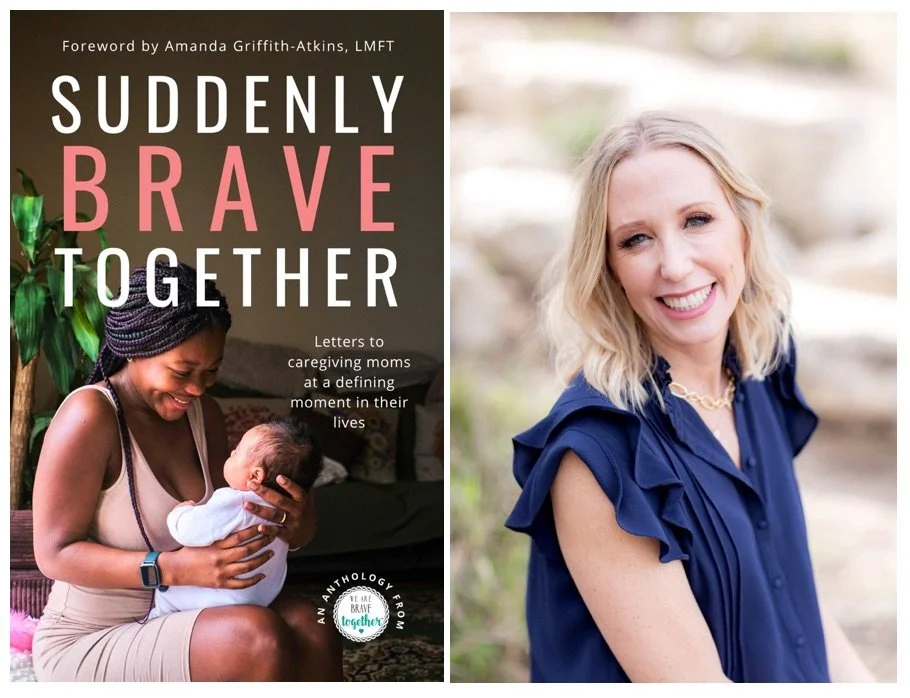
Image Description: Left side shows the book cover Suddenly Brave Together, Letters to caregiving moms at a defining moment in their lives. A woman stares lovingly at her child on her lap. On the right is the author, a blonde woman smiling with shoulder length hair in a blue shirt.
Estimated read: 4–5 minutes
There is no handbook for this life. No What to Expect When You’re Expecting…to Raise a Child With a Rare Disease, a Disability, managing 14 Specialists, in-home staff, an IEP team, insurance appeal affter appeal after appeal. Your mom may love you deeply. Your friends may want to help. Your pediatrician may be wonderful. And still, none of them may actually understand what this life feels like. That is exactly why Jessica Patay created We Are Brave Together
In this episode of Rarely Familiar, Haley, Jen, and Tram talk with Jessica about caregiving, grief, friendship, medical complexity, humor, advocacy, motherhood, and her new book, Suddenly Brave Together.
If you have 30 minutes, listen to the full episode. If you don’t because someone needs a refill, a ride, a prior authorization, a medication, or another medical mama needs to vent, or apparently your entire nervous system is broken today, here’s the good stuff.
How We Are Brave Together Started
Jessica’s caregiving story began when her son Ryan was diagnosed with Prader-Willi Syndrome at five weeks old. He was later diagnosed with autism at age seven.
After 17 years as a stay-at-home mom, Jessica launched We Are Brave Together nine years ago because caregiving moms need other women who truly get it. Not people who say, “I don’t know how you do it,” or immediately offer advice. Women who understand the exhaustion, the advocacy, the grief, the joy, and the bizarre combination of being both overwhelmed and incredibly capable.
As Jessica put it: “We need women in our life who really understand what our day-to-day life is like.”
Sometimes you do not need advice. Sometimes you need someone to say, “Yep. Same.”
What We Are Brave Together Actually Offers
What started in Southern California has grown into a national and international community of more than 4,500 caregiving moms.
The organization offers Connection Circles, which are support groups centered on listening and connection rather than fixing. Some are in person, some virtual, and some diagnosis-specific.
It also hosts 48-hour respite retreats around the country about eight to ten times a year. For $350, moms get two nights of housing, meals, snacks, coffee, programming, speaker sessions, and a goodie bag. Scholarships are available, and in 2024 the organization added a couples retreat.
A newer offering, Brave and Empowered, provides free mental health education twice a week for what Jessica calls the “unreachable moms” — those who are too isolated, exhausted, or overloaded to attend a retreat or support group.
And yes, they also have a Brave Together Podcast , because the more we talk about all this, the better!
The Books: Hope, Hard, and Everything In Between
Jessica has now helped create two books centered on caregiving moms.
Becoming Brave Together brings together stories from mothers raising children with different diagnoses, ages, and needs. Its purpose is not to make caregiving look inspirational and tidy. It is about the hope and the hard, the fear and the fierce love, and the reality that both can exist at the same time.
Suddenly Brave Together is written by moms of adult children and is designed for women earlier in the journey. Jessica described it as “a hand reaching across the universe to moms early on in their journey.”
That image really captures the book. It is not a five-year strategic plan. It is someone a little further ahead saying: I remember this part. You are not losing your mind. You will learn the acronyms. You will get better at asking questions. You do not have to understand all of it today.
The stories are intentionally short because Jessica understands her audience. Caregiving moms are not exactly known for uninterrupted reading time.
What Stuck With Us Most
One of the biggest themes in the conversation was connection before advice. In the earliest days after a diagnosis, people often rush in with resources, phone numbers, specialists, support groups, and next steps. Most of it may be useful eventually, but first a parent often needs someone to acknowledge that this is hard and disorienting.
Before “Here’s what worked for me,” there may need to be “I remember this part.”
Another powerful idea was that caregiving wisdom is often not inherited. Amanda Griffith Atkins writes in the book’s foreword: “We speak a shared language of appointments, advocacy and uncertainty. We celebrate what others might overlook. We grieve what could have been, while undoubtedly loving what is.”
That wisdom is often passed sideways from one parent to another, from the mom 15 years ahead to the mom who got the diagnosis last week, from someone in a waiting room, or from a stranger online at 2 a.m. who knows exactly what you mean.
And that is why these books should not only be read by caregivers. Jessica shared how her own sister gained a deeper understanding of caregiving after reading Becoming Brave Together, even after years of being close to her family.
We would love to see these stories in the hands of pediatricians, geneticists, researchers, therapists, educators, case managers, and anyone else who works with families. Sometimes the best way to understand a system is to hear from the people doing the work of navigating it every day.
Also, Please Let Us Laugh
Caregiving stories are often told as either heartbreaking or inspirational. Real life is usually much messier — and much funnier.
During the episode, Haley read a story from the book about a family noticing people staring at them on an airplane. They assumed the crowd was reacting to their child’s medical complexity. Nope. Apparently people thought they were looking at an interracial lesbian couple who had adopted a child with disabilities.
As Haley said, “When you’re not supposed to laugh, it’s infinitely funnier.”
Humor does not diminish the hard parts. Sometimes it is how we survive them.
There Are 4,500 Caregiving Moms Here. Just Saying.
The conversation also turned toward advocacy.
We Are Brave Together now has more than 4,500 members, which is not just a support network. It is a lot of lived experience, systems knowledge, and potential collective power.
For now, the organization is focused on connection, retreats, and mental health support, but Jessica acknowledged that advocacy could be an important future direction.
Caregiving moms are already advocating every day. The interesting question is what happens when thousands of those voices come together.
And What About Ryan?
Jessica also shared an honest update about her son Ryan, now 23.
After aging out of the school district, he went through a difficult season. The next program was not the right fit, his behavior changed, and there was frustration and what Jessica jokingly described as some “delayed teenagery anger” toward parents standing in the way of independence.
But things have shifted. “We now have our sweet Ryan back,” Jessica shared.
Their morning conversations have returned, along with his familiar warmth.
It was a reminder that difficult seasons can change, but also that caregiving does not magically end when a child becomes an adult. The systems simply change — and families often have to learn them all over again.
The Big Takeaway
Community is not fluff. For caregivers, it can be infrastructure.
It can be information, validation, emotional survival, and a reminder that you are not the only person trying to hold all of this at once.
That may be what Suddenly Brave Together does best. It gives women further down the road a chance to reach back and say: I remember. I learned some things. I made mistakes. I survived hard days. And you are not the only one doing this.
So…should you Listen to the full episode?
Yes.
Listen if you are raising a child with rare disease, disability, or medical complexity. Listen if you are a clinician, researcher, educator, therapist, case manager, or advocate who works with these families. Listen if you love someone who is caregiving and want to understand their life a little better.
And definitely listen if you have ever suggested “self-care” to an exhausted caregiver and would like a quiet opportunity to reconsider your choices.
The full episode is about 30 minutes and includes more of Jessica’s story, more about We Are Brave Together, the books, Ryan’s transition into adulthood, and plenty of those moments that make you think: Oh. Yep. Exactly.
Learn more: We Are Brave Together — www.wearebravetogether.org
RESOURCES
Dr. Zoe, licensed psychotherapist